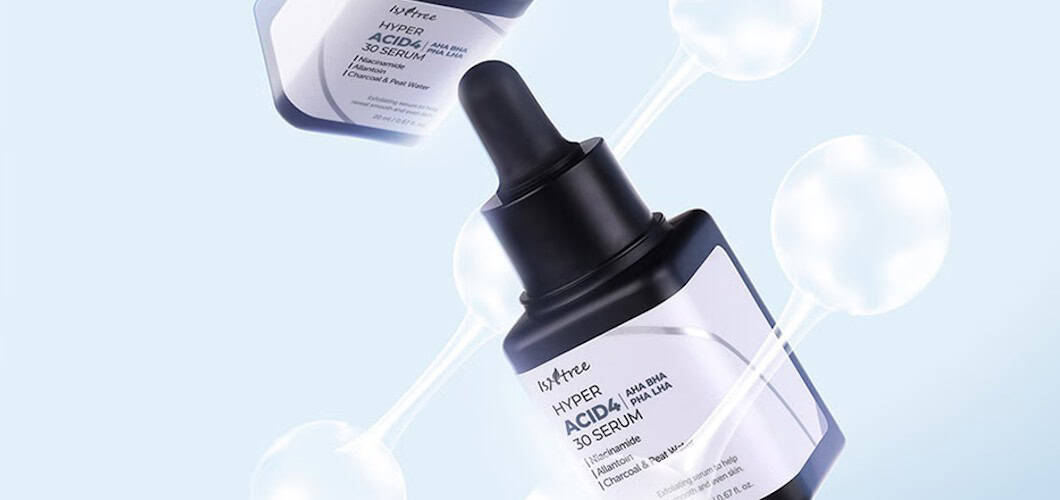

What are your thoughts about skincare acids?
For me, I was intimidated. Big time.
For years, I relied on other people recommending which acid I should use for my skin type and basically hoped for the best. Sometimes it worked. Quite often, it left my skin reeling, peeling and “purging” to the point where I eventually gave up on acids altogether.
The more I got into skincare, though, the more determined I became to actually understand what these ingredients were, what they did and—most importantly—why there were so many of them.
So, let’s make acids make sense.
First: Not All Skincare Acids Exfoliate
The word “acid” can sound terrifying, but chemically it simply describes certain types of molecules. Different skincare ingredients can share the word acid because of their chemical structure—not because they all do the same thing to your skin.
That distinction is really important.
Hyaluronic acid, for example, isn’t an exfoliating acid. It’s a humectant and is fantastic for adding hydration, which is why you’ll often see it in layering toners, essences and serums.
Tranexamic acid is another completely different beast. It has become popular in skincare for tackling hyperpigmentation and uneven tone. Research suggests it can interfere with pathways involved in excess pigment production, particularly in conditions such as melasma. It’s one of my absolute go to’s for all things blemish. I particularly love it in this eye cream from MARY&MAY.
The acids we’re focusing on here are the exfoliating crowd: AHAs, BHAs, PHAs and LHA.
And they are definitely not interchangeable.
AHAs: My Favourite All-Rounders
AHA stands for alpha hydroxy acid.
AHAs are water-soluble exfoliating acids that primarily work on the surface of the skin, helping loosen the bonds between dead skin cells so they shed more easily.
They can be brilliant for:
- Dullness
- Uneven texture
- Fine lines
- Post-breakout marks
- Hyperpigmentation
- Closed comedones and general congestion
Some of the most common AHAs are glycolic acid, lactic acid and mandelic acid.
Glycolic acid has a particularly small molecular size, so it can penetrate efficiently and can be incredibly effective—but that also means some skin types find it intense.
Lactic acid tends to be gentler and has useful humectant properties, while mandelic acid has a larger molecular structure and is often a lovely option for people who want exfoliation without immediately bringing out the big guns.
AHAs are probably the acid category I see the most consistent success with in my clients. Introduced slowly, they can help smooth texture, encourage stubborn closed comedones towards the surface and generally make skin look much fresher.
The important words there are introduced slowly.
Some favourite products would be the HARUHARU WONDER Black Rice Triple AHA Gentle Cleansing Gel, the COSRX AHA 7 Whitehead Power Liquid, and the MARY&MAYVegan CICA Tea Tree AHA PHA Blemish Toner.
BHA: Brilliant, But Very Easy to Overdo
Then we have BHA—beta hydroxy acid.
In skincare, when we talk about BHA, we are almost always talking about salicylic acid.
Salicylic acid is lipophilic, meaning it has an affinity for oil. That makes it particularly useful for oily, congested and acne-prone skin because it can work within oily environments such as clogged pores. It also has well-established comedolytic activity.
Or, in less scientific language:
BHA eats sebum for breakfast.
Not literally—but it certainly behaves very differently to a surface-focused AHA.
And that is exactly why I think salicylic acid is both brilliant and massively oversold.
If your skin is very oily, heavily congested or dealing with active breakouts, BHA can be fantastic.
But people often jump straight to strong 2% leave-on salicylic acid products because someone told them BHA was “good for pores”.
Then suddenly their skin feels tight, dry, irritated or flaky.
More is not better.
Personally, I often like BHA in a cleanser (like this one from COSRX) because contact time is naturally shorter. If I’m using it later in a routine—say in a toner, serum or treatment—I treat it as exactly that: a treatment step, not something that needs layering morning and night.
I also love alternating acid days with hydration-focused days. Skin needs a rest day!
PHA: The Gentle Giant
This is where *PHA—polyhydroxy acid*comes in.
PHA molecules are larger than many traditional AHAs, which is associated with slower penetration and more gradual surface exfoliation.
And I love them for sensitive skin.
Common PHAs include:
Gluconolactone, which exfoliates gently while also having humectant and antioxidant properties.
Lactobionic acid, another gentle exfoliating ingredient known for its moisture-binding properties.
PHAs can be particularly useful for reactive or easily irritated skin because you’re still getting exfoliation, but usually with much less drama. Here are two great skincare products with PHA as their hero ingredient: BIODANCE Skin Refining Mild PHA Toner and the AXIS-YPHA Resurfacing Glow Peel.
That larger molecular structure is one of the reasons PHAs tend to feel much more chilled than something like glycolic acid.
What About LHA?
LHA is one I really wish more people understood.
LHA stands for lipohydroxy acid, and you’ll usually see it referring to capryloyl salicylic acid, a lipophilic derivative of salicylic acid.
Like BHA, it has an affinity for oily environments. However, it penetrates relatively slowly and is associated with more gradual, targeted exfoliation.
This makes LHA incredibly interesting if you want something that can work around congestion without necessarily going straight in with a full-strength salicylic acid treatment.
I often think of PHA and LHA as cousins rather than twins.
PHA gives you that gentler, water-compatible surface exfoliation.
LHA gives you a more lipophilic option.
They are chemically different, but they share something I really value in skincare: control. They also work particularly well in the cleansing category: ARENCIA Green Tea + LHA Deep Pore Rice Cake Cleanser and MARY&MAY Rice Glutathione LHA Cleansing Oil.
Your Acid Percentage Isn’t the Whole Story
This is something I really want people to understand.
You cannot judge an acid product purely by the percentage written on the bottle.
Concentration matters, obviously, but so do:
- pH
- The delivery system
- Contact time
- Supporting hydrating ingredients
- Other actives in the formula
- How often you’re using it
- What you’re combining it with
Two products containing the same percentage of an acid can feel completely different on your skin.
This is why I hate the idea that stronger automatically means better.
Stronger is not better if your skin barrier hates you afterwards.
And a Little Shout-Out to Succinic Acid
Succinic acid is slightly different because I wouldn’t put it in the same traditional exfoliating-acid category as AHA or BHA.
I have one particular way of using succinic acid that has worked incredibly well for me and for my clients.
For stubborn blackheads, I saturate a pad with a succinic-acid product and leave it over the congested area for around 30–40 minutes. I use either the pre-soaked pads here from MEDICUBE, or the Blackhead melting kit from JUMISO.
Then I follow with a warm, slow and concentrated oil-cleansing massage.
I regularly find the congestion feels softer afterwards, and sometimes blackheads loosen or release during the oil cleanse. And don’t go aggressively squeezing afterwards. We’re trying to coax congestion out—not declare war on your nose.
So, Which Skincare Acid Should You Choose?
Rather than asking, “Which acid is best for my skin type?”, I think the better question is:
“What am I actually trying to achieve?”
Want to tackle dullness, texture or pigmentation? Look towards AHAs.
Very oily and heavily congested? BHA may make sense.
Sensitive but still want some exfoliation? PHA could be your best friend.
Want something oil-soluble but potentially more gradual? LHA is absolutely worth knowing about.
Most importantly, start slowly.
One acid. One product. Give your skin time to tell you what it thinks. Here’s an article about how long it can take to start seeing a difference in your skincare.